Calgary’s Heritage Park Historical Village
Links to the other areas of Canada
| CALGARY’S HERITAGE PARK Heritage Park is situated on 127 acres of land at 1900 Heritage Drive SW, just 20 minutes from downtown Calgary. It opened its gates to the public on July 1, 1964 and is Canada’s largest living history museum, featuring a village recreated to appear as it might have been, in early-20 Century Alberta. Most of the buildings are historical and were transported to the park at the end of their life. The Park features a Railway Area, which includes a roundhouse, car shop and a turntable built in 1907. The roundhouse and car shop are open to the public and the turntable is heavily used during Railway Days, a 2-day affair usually on a July or August weekend. Access www.heritagepark.ca for more details. |
 | Long before there were LED crossing lights, there was the wigwag signal. In small towns, the changeover to crossing lights, was as late as the 1980s. There were several models produced in US and Canada. The US models had a slightly different design. This view shows the model in very wide use, all over Canada by CN and CP. Just like today, as a train approached the road crossing, a spring released the arm and the signal oscillated back and forth under control (hence the name wigwag), while a large bell above rang with a “ding-dong” sound matching the swinging of the arm, to warn motorists and public. After the train had passed, the arm retracted into the cover and locked and the bell silenced until the next train. |
| This picture was taken and submitted by Massey F. Jones | |
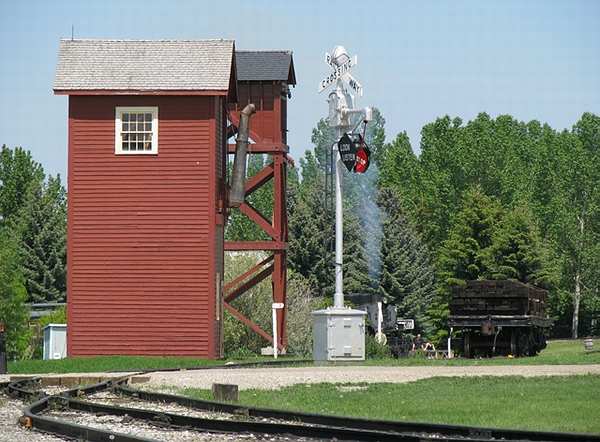 | The square water tower at Calgary’s Heritage Park still provides a steady supply for steam locomotives CP2013 and CP2014 during the Park’s open season from May to September. Notice one of the smoke plume of a steam engine in the background. The locomotive in use that day is watered around 5:30pm, near the park’s closure. Note the wig-wag signal, featured elsewhere on these pages. The Railway Water Tower was built in 1902 and the adjacent Railway Sand House, circa 1920. |
| This picture was taken and submitted by Massey F. Jones | |
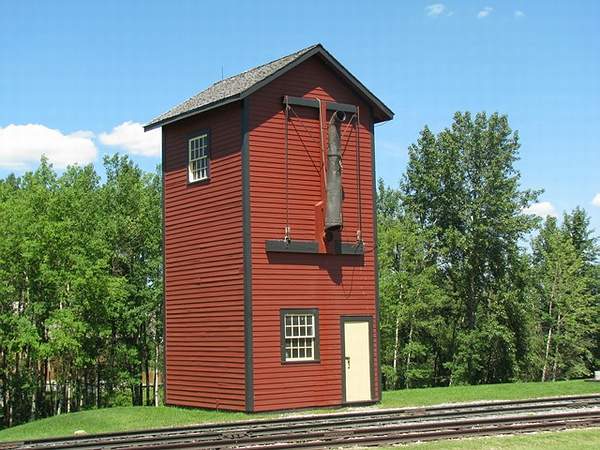 | During steam days, smaller locomotives needed to be filled with water for their boilers about every 50 miles or so. One common type was the octagonal enclosed water tower with a ball on a central mast to indicate the level, such as at Glenboro MB and Kenaston SK. They contained a heater to prevent water from freezing in winter. As years went by, bigger centres, such as Brandon MB had large steel tanks. All three examples are shown on the Stations page: http://yourrailwaypictures.com/TrainStations/index Central.html This one at Heritage Park is a rectangular water tower which was built in 1973 from a 1902 CPR plan, using plumbing parts permitted by the CPR to be salvaged from East Coulee, Alberta (east of Red Deer). The tracks nearest to the water tower are the mainline around the Park and the other one a side track. |
| This picture was taken and submitted by Massey F. Jones | |
.jpg) | A Heritage Park staff member demonstrates how the locomotive water tender is replenished on the CPR 2023 hauling a freight train, during Railway Days, September 28-29, 2013. During the open season May-October, either the 2023 or 2024, travels an average of 45 miles (approx. 72 km), from approximately 10:00 am to 5:30 pm daily and uses around 1700 Imperial gallons (about 7730 litres) of water from this water tower. |
| This picture was taken and submitted by Massey F. Jones | |
.jpg) | Sand provides help with braking and traction on icy rails but Heritage Park locomotives do no t usually operate during the winter. This sand house is never used, firstly because it does not have the required plumbing and secondly, it needs a bin full of sand at the bottom and a compressor system, to bring the sand to the top; where it is then fed into the locomotive’s sand dome. Just the same, the structure illustrates what a CPR sand house would have looked like. During the 1920s, the Canadian Pacific Railway built this sand tower at the Alyth Yards in Calgary. It was used in Red Deer from the mid-1960s until 1976, when the CPR donated it to Heritage Park, where it was rebuilt in 2008 incorporating many of the original components. |
| This picture was taken and submitted by Massey F. Jones | |
.jpg) | Shepard Station at Calgary’s Heritage park, 1900 Heritage Drive SW. Shepard is still an active CPR point on their Brooks Sub between Medicine Hat and Calgary, (about 10 miles east Calgary’s Alyth Yard). CPR named the station after one of the contractors who built the railway across the Canadian Prairies, from Flat Creek (near Virden MB) to Calgary AB. Using 2000 men and 400 horses they laid 675 miles of track during 15 months, including 67 miles of track in June 1883 . |
| This picture was taken and submitted by Massey F. Jones | |
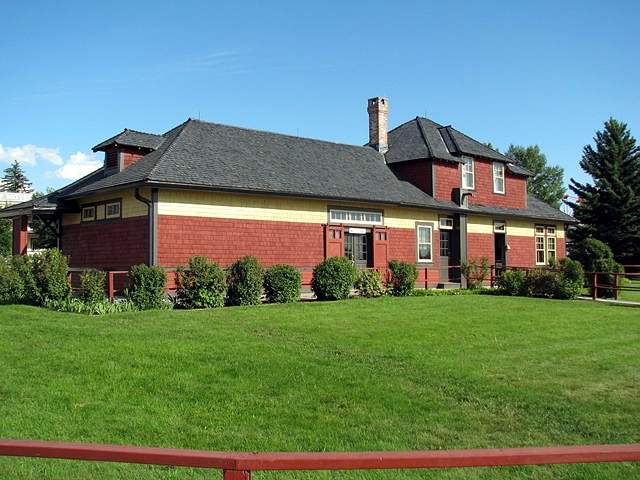 | The rear of Shepard Station. The large portion on the left side was the freight shed and is now used as a snack bar area for Heritage Park visitors. Like Midnapore Station, it features washroom facilities. http://www.heritagepark.ca/plan-your-visit/attractions -and-exhibits/shepard-station.html |
| This picture was taken and submitted by Massey F. Jones | |
.jpg) | The station, built in 1910, was donated to Heritage Park by the CPR when it became vacant and now provides visitors with ticket sales, food services, water fountain and public washrooms. It is also wheelchair accessible. The far side features a small lunch counter with a few tables. |
| This picture was taken and submitted by Massey F. Jones | |
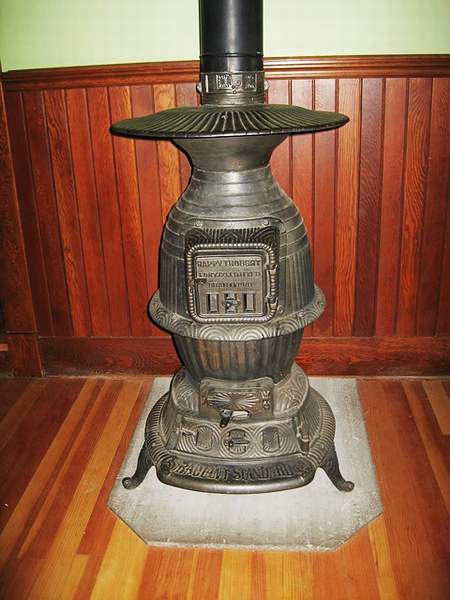 | The “Happy Thought Standard” stove in Shepard station at Heritage Park. Each one of their 3 stations has an al old fashion stove that they use only as an artifact. The “Happy Thoughts” stove brand was first manufactured by the William Buck Stove Company of Brantford, Ontario. William Buck started making stoves in the 1850s and died suddenly of heart disease on July 15, 1897. The McClary Company of London, Ontario; then purchased the plant around 1920 and the factory became known as the Happy Thought Foundry Company. The Happy Thought Foundry Company closed at the end of 1931 when all manufacturing was moved to London, Ontario, after McClary became General Steel Wares through a merger. |
| This picture was taken and submitted by Massey F. Jones | |
__crop.jpg) | A close-up of the Happy Thought Standard stove. Like all other early stoves, the middle door was designed to insert wood or coal and the bottom door was used to remove the ashes with a small square shovel. In every Heritage Park wired the doors shut on all the stoves in their 3 stations, to prevent tampering. |
| This picture was taken and submitted by Massey F. Jones | |
 | Midnapore Station, built in 1910 of the CPR Type A-2 design. The station, located in the deep south part of the Calgary used to be called Fish Creek” but the postmaster renamed it Midnapore when he saw a letter addressed to Midnapore India, mixed in with Fish Creek’s mail. The station was always occupied by a single station agent who lived upstairs with his wife, before moving on to other stations. Due to wartime manpower and lack of business, the station was closed in 1918. CPR then allowed the station to be occupied by caretakers during the 1940s and 1950s to prevent burglary vandalism, before it was sold to Heritage Park in 1964 for $1, with the stipulation that the building be taken away and the site cleaned up. Before 1972, Midnapore Station served as the administration building for the park and today, is basically the beginning and the end of the Heritage Park steam trips. During Railway Days in late summer, the station is home to various rail-related displays, such as telegraphy, watchmaking etc. |
| This picture was taken and submitted by Massey F. Jones | |
 | Approaching Midnapore Station from the south, viewed from the train. |
| This picture was taken and submitted by Massey F. Jones | |
 | Midnapore Station, looking south from the train |
| This picture was taken and submitted by Massey F. Jones | |
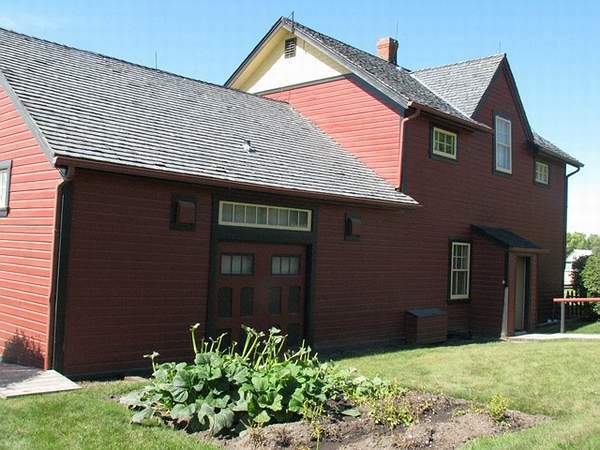 | The rear of Midnapore Station. This area was more or less reserved for the stationmaster’s family and it was customary in those days to grow a vegetable garden in back. Also notice their private entrance. Usually, the family lived upstairs. To the left, the double doors led into the freight shed. http://www.heritagepark.ca/plan-your-visit/attractions -and-exhibits/midnapore-station.html |
| This picture was taken and submitted by Massey F. Jones | |
 | The Station Agent desk with customer counter in the foreground. |
| This picture was taken and submitted by Massey F. Jones | |
.jpg) | A common sight for passengers entering a 1910 of the CPR Type A-2 design. To the left, the YWCA Traveller’s Aid, available to help young ladies during their journey with information, etc. |
| This picture was taken and submitted by Massey F. Jones | |
 | Inside Midnapore Station looking south, with customer service through the rectangular window. Like other railway stations in Heritage Park except Bowell, the Midnapore station features a potbellied stove as an artifact. Because it got very hot when in use, the stove was raised off the floor on cast iron feet. A sheet metal pan was usually placed under the stove to prevent burning the floor and help catch some of the stray ashes or cinders. The chrome plated ring around the stove is not just for decoration but to guard against people accidentally getting burned when walking past the stove |
| This picture was taken and submitted by Massey F. Jones | |
.jpg) | The door of the potbelly stove was hinged to insert wood inside or take out the ashes. When hot, a poker (used to stir up the wood within the firebox while burning), was used to prevent burned fingers. The knob in the center grate helps control the draft within the firebox. Notice the nickel-plated skirt around the stove. It is not there just for decorative purpose but to help distribute the heat. |
| This picture was taken and submitted by Massey F. Jones | |
.jpg) | Close ups of the pot-bellied wood stove at Midnapore Station. The Station Agent stove was manufactured specifically for the railroad companies to heat their stations. The flat top could be used for cooking or water boiling. This one was built around 1905. The stove is 48″ tall and 24″ in diameter. Today, one of these in restored condition sells for around $4000.00 |
| This picture was taken and submitted by Massey F. Jones | |
.jpg) | View the Gurney 1892 line of stoves at: http://www.stovebook.com/1892_Gurney_Stove_ Catalog.pdf and make a note of prices for their products, such as $67.50 for a large 10 cooking hole kitchen range. Equivalents of this model pot-bellied wood stove for home use, sold for around $19.00 at the time. Today, we can move the decimal completely to the right. |
| This picture was taken and submitted by Massey F. Jones | |
 | CPR # 144 at Calgary station. The caption states that the first passenger train reached Calgary Aug 1883. This is the second station in Calgary (the first was a boxcar). Both buildings were eventually taken down when a much larger station was built a block further west. One building then became the High River CPR station, the other the Claresholm CPR station, both a few miles south of Calgary. On 28 Jul 2010, the High River station (now Museum of the Highwood) sustained fire damage |
| This pictures is from a framed photograph in a Calgary restaurant. It was submitted by Massey F. Jones | |
 | This plaque, affixed to a wall of the Calgary CPR Station replica at Heritage Park depicts the 3rd Canadian Pacific Station at 9 Avenue and Centre Street South in Calgary, in a trackside view looking north in 1909. Constructed in 1893, the station was built of locally quarried sandstone, similar to the material used in many homes in the city. Between 1910 and 1911 dismantled stone by stone. The west half (to the left of the picture) became the High River CPR station and the east half (to the right) was moved to Claresholm Alberta, to become its CPR station. The High River CPR station subsequently renamed “Museum of the Highwood” and housing railway and ranching artifacts, was damaged by a fire on July 28th, 2010. After some restoration, it was again damaged June 21, 2013 by the waist-deep flood which engulfed the downtown part of High River. The original image is from the Glenbow Archives (NA-1497-11) |
| This picture was submitted by Massey F. Jones | |
 | In 1989-1990, the Heritage Park main gate was relocated and the park went through an expansion. To serve the needs, a replica of the 1893 Calgary CPR station was constructed to serve visitors needs with an orientation centre, and a restaurant (Railway Café) which is designed in the traditional CPR theme. Due to its location in Heritage Town Square, just outside the main gate, it requires no admission. This view show the back of the replica station. |
| This picture was taken and submitted by Massey F. Jones | |
 | A back view of the 1893 Calgary CPR station. Notice the fine workmanship, using modern materials. |
| This picture was taken and submitted by Massey F. Jones | |
.jpg) | The CPR Garden stands adjacent to Heritage Park Town Square, the site of some artisan shops including a portrait studio (in turn-of-century clothes), a tutorial-type micro brewery as well as an old fashioned bandstand, the site of periodic free concerts. |
| This picture was taken and submitted by Massey F. Jones | |
.jpg) | Railway gardens began to be planted in the 1890s by station agents wanting to hide railway construction around their station. Soon, there was competition between them, to see who had the best garden. In addition to beautifying the station, gardens provided a rest area for travelers between trains, especially for those who could then walk their pets. |
| This picture was taken and submitted by Massey F. Jones | |
 | The front side of the 1893 Heritage Park replica CPR station, viewed from the Heritage Town Square in May 2013. The steps lead to the main entrance of the Railway Cafe; their dining venue outside the main gate |
| This picture was taken and submitted by Massey F. Jones | |
.jpg) | While wealthy passengers usually went to the adjacent hotel for a meal during a train layover; hundreds who passed through Calgary yearly patronized the station’s lunch counter, offering soup, sandwiches, pastries and coffee at a more affordable price. The Railway Cafe seeks to replicate the elegance of a 1930s lunchroom. The 3rd Calgary CPR Station featured two buildings linked by a canopy. One of the buildings was the ticket office/baggage room and the other one was probably the restaurant/waiting room. In larger railway stations such as Calgary and Vancouver, counters were usually curved to accommodate the maximum number of customers, in the least space. |
| This picture was taken and submitted by Massey F. Jones | |
.jpg) | Visitors entering from the Heritage Town Square make their selection at the far right and then can either move to a couple of nearby tables or into the dining area on the other side of the curved counter, for more privacy. |
| This picture was taken and submitted by Massey F. Jones | |
.jpg) | Entering the double doors (pictured elsewhere), brings visitors directly into the lunchroom In keeping with tradition; there are stools along the counter for single diners and those in hurry, as well as tables for families or those with more time to spare between trains. Notice the coffee grinder on top; as at the turn of the last century, instant and pre-packaged coffee did not yet exist. Due to its location before the Park gates in Heritage Town Square, the Railway Café requires no park admission. It is open year-round and serves a light fare, all dishes being prepared on-site and priced at $15 or less. Once inside the gates, there is more food available, ranging from ice cream and homemade pastry to fine dining. |
| This picture was taken and submitted by Massey F. Jones | |
 | The Canadian Pacific was laying track West at such a pace before 1914, that it didn’t have time to build a proper station in every hamlet located trackside to serve farmers and homesteaders. To remedy the situation, the railway dropped off a “portable station”; basically a boxcar on skids, which only cost $100 to build (a good sum in those days), to provide a ticket office and waiting room. Unlike permanent stations later constructed in bigger hamlets or junctions, portable stations did not provide for a trackside station agent overlooking movements and were more or less just a flag stop, opened at certain hours. Bowell station at Heritage Park was the actual 1909 depot, located a few miles northwest of Medicine Hat. It as not uncommon in those days to name stations after public figures and this one was named after Sir Mackenzie Bowell, Prime Minister of Canada 1894-96. Canadian Pacific Railway donated the building to Heritage Park in 1964 when they started their collection and the Park now uses it solely as an efficiently divided washroom. The track in front is the “mainline” circling the Park. |
| This picture was taken and submitted by Massey F. Jones | |
 | Laggan Railway Station, at Heritage Park is the original Lake Louise train station, built of peeled logs in 1891. In 1909, the structure was converted to a baggage shed when a new more spacious log station was built at Lake Louise. Surplus to CPR requirements, the baggage shed was dismantled 1976 and moved to Heritage Park where it was reassembled and restored to its original beauty. When this station was in use, horses carried passengers in wagons for some distance to the Lake Louise Lodge, some distance away but with an elevation of 800 feet (roughly 243 m). Complains led the CPR to have the line serviced by the famous self-propelled Lake Louise Tramway, shown in these pages. http://www.trainweb.org/oldtimetrains/CPR/travel/ tramway.htm |
| This picture was taken and submitted by Massey F. Jones | |
 | Ironically.,the log station which replaced the structure shown in this picture, was itself converted into a trackside restaurant, when VIA Rail abandoned passenger service through the CPR Laggan Subdivision in January 1990. Freight trains and special runs still use the track at all hours but do not stop at Lake Louise anymore. |
| This picture was taken and submitted by Massey F. Jones | |
 | The operator’s station at Laggan Station in Heritage Park. Some basic tools are seen, consisting of railway lanterns, telegraphy equipment, as well as an Underwood typewriter. The green board in the centre of the picture between the windows, holds a chain for working the track signal board, either turned face-on and fully visible to the engineer and fireman, or rotated away so as to be practically invisible. Hence the railway term “Clear Board”. Some rotated two ways, some 3 ways, on a pivot usually attached around the roof area. Laggan Station is serviced by the Heritage Park steam train, which stops in front of it, on every alternate trip. A full trip around takes approximately 45 minutes and covers the Park perimeter twice. Passengers are free to get off at any of the 4 stations covered on this page and then re-board. |
| This picture was taken and submitted by Massey F. Jones | |
 | Heritage Park Roundhouse and Car Shop The car shop is on the top and the roundhouse on the bottom. |
| This picture was submitted by Massey F. Jones. It was taken from Google Earth | |
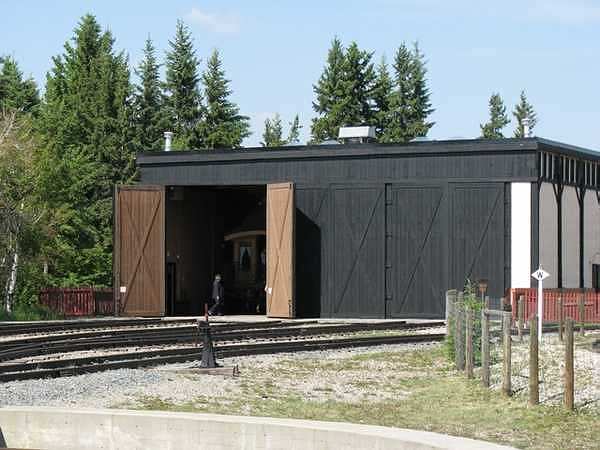 | The Railway Car Shop is open to the public at Calgary’s Heritage Park. It houses several preserved historic cars from the 1880s to the 1920s, with the average being from 1910. One of them can be seen just inside the open doors. Part of the turntable pit can be seen in front. |
| This picture was taken and submitted by Massey F. Jones | |
 | The interior of the car shop at Heritage Park in September 2013. Left-to-Right: Car 76 “Construction Car” (1882), Car 141 (1907), used as a passenger coach, then work car; Car 100 “YORK” (1901) lettered “Dominion of Canada” and used by the Governor General and other dignitaries, CP 5 “RUPERTSLAND” ((1902) and CP 2658 “COLONIST CAR” (1912). Hidden behind Car 141 in a replica of a Winnipeg horse streetcar. Various pieces of track maintenance equipment occupy the centre aisle. The interior of the Colonist Car will be covered on this page soon. |
| This picture was taken and submitted by Massey F. Jones | |
 | Among the artifacts preserved because of historical value, is the Car 100 YORK, now located in the Car Shop at Heritage Park. It was constructed in September 1901 for the Royal Train, transporting the Duke and Duchess of Cornwall during their visit to Canada http://www.cwjefferys.ca/recollections-of-the-royal-tour -of-1901#.UmCFAnCsg6Z In 1906, it started in service on the Canadian Pacific Railway as Car 100 YORK. After being acquired by the Federal Department of Railways & Canals http://en.wikipedia.org/wiki/Department_of_Railways_ and_Canals_(Canada) in March 1928, the heavyweight luxury car was used to transport the Governor General and occasionally by Liberal Prime Minister William Lyon Mackenzie King. |
| This picture was taken and submitted by Massey F. Jones | |
 | Car 100 YORK went through renumbering several times in the Canadian National passenger car series, before coming to Regina in 1985 as a Simpson Sears executive car and to Heritage Park some time later. |
| This picture was taken and submitted by Massey F. Jones | |
 | A platform at the front end of the car allows visitors to inspect the opulent interior of heavyweight passenger car 100 YORK |
| This picture was taken and submitted by Massey F. Jones | |
 | The rear platform of Car 100, viewed from another exhibit in the Heritage Park Car house. |
| This picture was taken and submitted by Massey F. Jones | |
 | A bedroom in one of the sections, presumably no for the VIP himself, as it features a fold down bunk at top left. Notice the fine wood grain. The car is planned for restoration at a later date. |
| This picture was taken and submitted by Massey F. Jones | |
 | The intimate dining area of passenger car 100 YORK |
| This picture was taken and submitted by Massey F. Jones | |
 | Displayed in the Heritage Park Car Shop at one end of the Colonist Car in the foreground and car 100 YORK to the left, is the historic car RUPERTSLAND. There are a couple of references to the car in the text on my steam engine page http://yourrailwaypictures.com/CPRsteamengines/ near the top under the very narrow picture of the first train arriving in Lloydminster AB. The car was constructed in built in January 1905 and served as CP Dining Car WARWICK in 1917, before being being converted to CP Parlor Car 5702 in 1918. It then underwent a series of name changes, bearing the name RUPERTSLAND, from 1946 to 1947. It then became CP BRITISH COLUMBIA until 1961. http://www.rrpicturearchives.net/showPicture.aspx?id= 1512394 before finally becoming CP 5 in 1969. The stairs in the foreground make the interior of the car available for viewing by visitors, during the Park’s open hours. |
| This picture was taken and submitted by Massey F. Jones | |
 | Canadian Pacific Railway Car 76, one of the rarest pieces of Canadian railroad history. This is not a replica, but the actual car which was used for transporting dignitaries from Calgary. Lord Strathcona drove the last spike and marked the completion of the Canadian Pacific Railway on November 7, 1885, west of Revelstoke in Eagle Pass . http://commons.wikimedia.org/wiki/File:LastSpike _Craigellachie_BC_Canada.jpg Still well able to be on the mainline; it returned there in November 1985, led by steam locomotive CPR 1201 (shown in these pages) with a special train of today’s dignitaries, for the commemoration, 100 years later. Car 76 was built by Harlan and Hollingsworth in May 1882 and served as a construction car for the Landon & Shepard & Company, which laid CPR track west. It bore a variety of names and numbers on the CPR during its lifetime, before ending up on the Northern Alberta Railway as NAR Official Car 3 in January 1964, and acquired by Heritage Park who restored it to its former splendor. In intimate circles, Car 76 is still referred to as “The Construction Car”. Now protected from the elements in the Heritage Park car shop, it only ventures out on special occasions but can be toured inside. The painted panel in front, enables kids to stick their head into a cut out portion and have a picture taken with the group laying The Last Spike. |
| This picture was taken and submitted by Massey F. Jones | |
 | Car 76, on display in the Railway Car Shop was present at the driving of the last spike Canadian Pacific Last Spike, joining East and West on the morning of November 7, 1885 and again at the 100th anniversary in Craigellachie, B.C in November 7, 1985 during the ceremonies. The century-old car is fully roadworthy and approved for mainline track.Craigellachie is featured on my station page http://yourrailwaypictures.com/TrainStations/indexBC.html |
| This picture was taken and submitted by Massey F. Jones | |
 | In 1972, Heritage Park built a replica of a four-wheeler horse drawn streetcar used on the Winnipeg Street Railway. The route inside the Park was extended in 1973 and it operated the Winnipeg Streetcar #8 until 1990. It was moved into the Railway Car Shop as a permanent display in 1998. Winnipeg operated an animal railway from 20 October 1882 to June 1894, before switching to electric |
| This picture was submitted by Massey F. Jones, courtesy Heritage Park | |
 | The car is now on permanent display in pristine condition at the back of the back of the Car House. The minimal friction of steel wheels on steel rails (or iron on iron) allowed a horse to pull a larger load and make better time than he could with a road vehicle. Public Transit, in the form of horse car, first ran in Winnipeg on October 20,1882. Fares were $0.10 cash or 15 tickets for $1.00. In the winter fares dropped to $0.05 cash per ride. The Winnipeg Street Railway Company was founded by a young entrepreneur from Toronto named Albert William Austin. |
| This picture was taken and submitted by Massey F. Jones | |
 | The front end of horse car #8, showing the interior as seen by the public exiting the platform of “Construction Car” #141. The steel crank above the dash is the hand brake, used by the conductor on downgrades. Among some of the disadvantages of a horse car, is that they could not easily be pulled up hills by the horse. Also running all day would require a change of horses. The horses would also have to eat periodically and soiled the streets. |
| This picture was taken and submitted by Massey F. Jones | |
 | At befits the period, the interior of an 1880 horse car is extremely basic as it is merely used to transport people between 2 points out of the weather. And in its day, the seats of Winnipeg horse cars must have been just plain varnished wood. Among other Winnipeg Transit facts, there’s a period picture of a horse car on a Winnipeg street at: http://winnipegtransit.com/en/inside-transit/ interestingtransitfacts |
| This picture was taken and submitted by Massey F. Jones | |
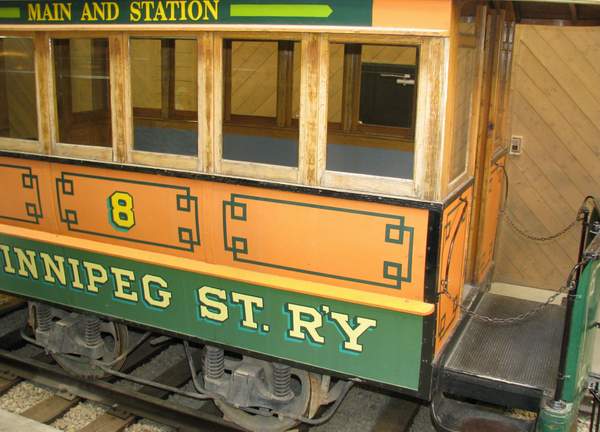 | The rear of Winnipeg St. Ry replica on permanent display in the Heritage Park Car House. This gives a very good idea of graphics applied to the car. |
| This picture was taken and submitted by Massey F. Jones | |
.jpg) | The south wall of the Heritage Park roundhouse on 22 Sep 2-13. To the far right is CP Jordan Spreader 402829 and behind it, the CP 414328, 50-Ton Bucyrus crane, both featured on this page, about to be restored.. In the background is an unidentified boxcar, also to be restored. Steps have been set up, to allow visitors a glance inside a boxcar. The gentleman with the broom in the centre is one of the costumed Heritage Park staff, on site to explain railway artifacts to visitors. The broom is only one of the many props in use. Others are purposely old vehicles locally manufactured, to transport staff internally etc. All Heritage Park staff dealing with the public are costumed in period dress 1890-1920, by the Park’s wardrobe department. |
| This picture was taken and submitted by Massey F. Jones | |
 | An area of the Heritage Park was set aside for model railroader layouts during Railway Days; September 28-29, 2013.Railway Days are designed to showcase the long history of railway in Calgary with turntable demonstrations, locomotive watering and model railroading from local clubs. The two days also feature spike driving, double heading by their 2023 and 2024 with freight and passenger cars, as well as displays of the Park’s rail artifacts in various areas, with interpretation by knowledgeable staff. This year it provided hand car rides for young and old on a short bit of track. Young staff member on one side and guest pumping on the other side. In the back, Jordan Spreader CPR 402829 (built 4/1912), about to undergo restoration. The hook of 75-Ton Bucyrus steam crane 414328 can also be seen at the far left centre. It is also undergoing restoration. Both are featured on this page. |
| This picture was taken and submitted by Massey F. Jones | |
.jpg) | Snowplow 400884 was built December 1911 in the CP Montreal’s Angus Shops and originally numbered 300884 before getting its new number in 1991. It is now displayed in Calgary’s Heritage Park roundhouse, alongside a few other artifacts. |
| This picture was taken and submitted by Massey F. Jones | |
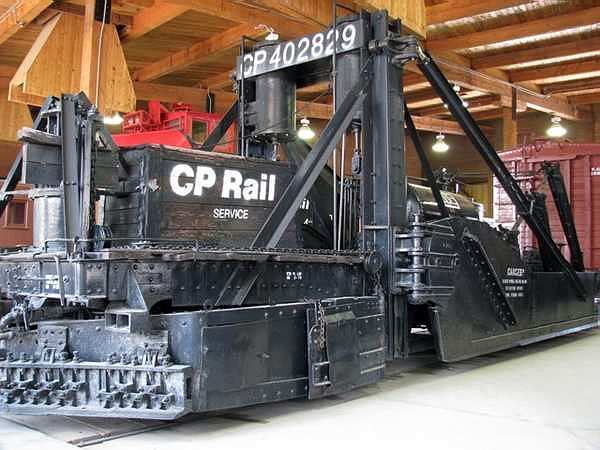 | Jordan Spreader CP402829 sits in the Heritage Park roundhouse in Calgary. It was built in Southern Ontario in April 1912 (ser# 229) and still bears its original number. |
| This picture was taken and submitted by Massey F. Jones | |
 | CP wood slat caboose 6209 was built in 1912 as 436209. It sits in the roundhouse at Calgary’s Heritage Park and is in regular service when a freight train is put together. |
| This picture was taken and submitted by Massey F. Jones | |
 | Canmore Mines #4 while in operation. It was built by the Canadian Pacific in February 1905 and they numbered it 2144 in 1912, then 6144 in 1943. It is a 0-6-0, which means no leading or trailing trucks and was mostly used as a switcher by CP, before being sold to Canmore Mines around 1963. After Canmore Mines Ltd. ceased coal production in 1979, the locomotive was eventually donated to Heritage Park as a historical artifact. The Park converted it to diesel power and it became Heritage Park No.4, which they used occasionally as a switcher, before renumbering it to CPR 2018 and displaying it to the public in the Roundhouse. Canmore, about 20 km east, became the overflow for Banff by backpackers and other outdoor enthusiasts seeking more basic accommodation up to the mid-80s Now with 12,000+ souls, it played a great part in 1988 Olympic events, such as cross country skiing and Biathlon because it is ideally situated in the Canadian Rockies and less than 40 minutes west of Calgary |
| This picture submitted by Massey F. Jones | |
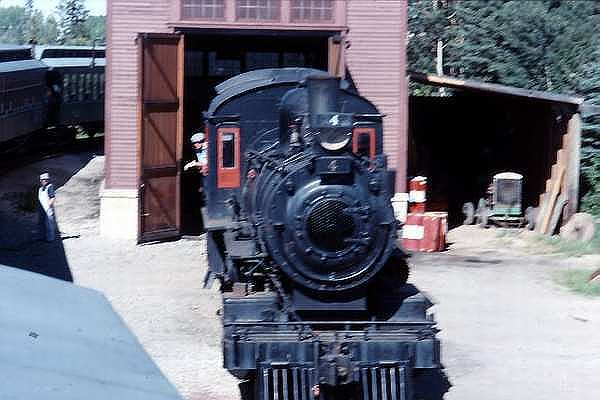 | Ex Canmore Mines #4, now “Canadian Pacific 2018,” taken on the run from a caboose, during Heritage Park Railway Days, September 1992. It is about to be run for the public, as can be seen in the next picture, after our train has cleared the track. Heritage Park Railway Days is an annual 2-day event; where double heading, switching turntable operation and other rail-related events take place. Access www.heritagepark.ca for the current dates. |
| This picture was taken and submitted by Massey F. Jones | |
 | A rear view of Canmore Mines #4 about to go on the Heritage Park “mainline”, in a photo, again from the caboose. The 0-6-0 locomotive, built by the CPR in February 1905 (Ser# 1392) has now been converted to diesel power and the exhaust plume can be clearly seen in the photo as it is preparing to depart . Compare the #4 to the photo of the CP 2018 on this page, when it’s now wearing a nose cone for display. We have left a historic car behind and the #4 will now switch it for the Railways Days visitors. |
| This picture was taken and submitted by Massey F. Jones | |
 | CP2018 on static display in the roundhouse at Calgary’s Heritage Park was built by the CPR in February 1905 (Ser# 1392). It was in service as CP2144 in 1912, then CP 6144 in 1943. It next bit of service was at Canmore Mines (near Banff AB) as their No 4., before being acquired by Heritage Park, who converted it to diesel power. It is presumed that the nose cone is removed (for air intake) when the loco is running. |
| This picture was taken and submitted by Massey F. Jones | |
 | Notice the steps leading into the cab for public viewing in the Calgary Heritage Park roundhouse |
| This picture was taken and submitted by Massey F. Jones | |
 | One of two views of the CP2018 gauges, some modified from the original concept because the former steam loco is now dieselized |
| This picture was taken and submitted by Massey F. Jones | |
.jpg) | One of two views of the CP2018 gauges, some modified from the original concept because the former steam loco is now dieselized |
| This picture was taken and submitted by Massey F. Jones | |
.jpg) | The rear of the roundhouse at Heritage Park, built to provide a repair facility for their rolling stock and showcase a few exhibits indoors, in addition to their Car House on the other side of the turntable. It represents a typical CPR roundhouse in Western Canada before 1915. The roundhouse is always open to the general public during the park operating hours. This view is the east wall from Shepard Station, next door. Heritage Park does 95% of its maintenance on site. The Railway Roundhouse was financed by a grant from the Alberta Heritage Fund for Alberta’s 75th Anniversary and opened in 1981 |
| This picture was taken and submitted by Massey F. Jones | |
 | 2023 at Shepard Station in Heritage Park. In this photo, the locomotive is pulling a freight train during Railway Days 28-29 Sep 2013. |
| This picture was taken and submitted by Massey F. Jones | |
 | A semi-telephoto shot of Heritage Park 2024, clearly showing air cylinders and apparatus at the front. The locomotive is waiting at Laggan Station. |
| This picture was taken and submitted by Massey F. Jones | |
.jpg) | The wheel arrangement of CPR 2024, during a rest stop at Shepard Station in Heritage Park. CPR is a 0-6-0 locomotive, meaning that it has no leading or trailing truck. It was built by Lima Locomotive Works (Ser# 8410) in January 1944 for the US Army who used it as their 4076. It then switched cars on the Pacific Coast Terminals in Vancouver as their 4076, before being sold to a private owner, before coming in Heritage Park service. It was painted CPR 6269 (seen elsewhere on this page) between 1967 and 1969 and then renumbered to CPR 2024. Like her sister CPR 2023, the 2024 was never owned by the CPR but was given a “pretend number” by Omer Lavallée, the late CPR Corporate Historian. |
| This picture was taken and submitted by Massey F. Jones | |
.jpg) | Another view of the CPR 2024 wheel arrangement and connecting rods. The railway at Heritage Park uses 100-pound rail on a standard gauge track (four feet, 8½ inches wide – 1,435 mm), and its main loop is 4,300 feet long (1,310.64 m). |
| This picture was taken and submitted by Massey F. Jones | |
 | Yet to be restored is 75-ton Steam Crane 414328 built by Bucyrus in 1920 (Ser#181) and placed in service as CP 400167 about 1930, before being renumbered with its present one. The tender was part of a small 0-6-0 locomotive. The item on top of the flatcar is a small mine car, yet to be restored also. |
| This picture was taken and submitted by Massey F. Jones | |
 | One of the piston rods activating the Canadian Pacific 414328, 75-Ton Bucyrus Steam Crane, can clearly be seen here inside the Heritage Park roundhouse in September 2013; as the sides has now been taken off for restoration and viewing. Heritage Park has a history of restoring their artifacts to superb quality. You can see the rod and piston in operation on the preserved Bytown Railway Society (Ottawa), Central Vermont steam crane at: http://www.youtube.com/watch?v=k81SDuG8JYg |
| This picture was taken and submitted by Massey F. Jones | |
 | The Bucyrus Crane now undergoing restoration in the Heritage Park Roundhouse on August 2nd, 2014. While Heritage Park has a reputation of rebuilding better than new, it could only apply mostly to the exterior. and a bit of the interior for static display. Missing from the steam crane is the chimney, which is now sitting on flatcar Morrissey Fernie & Michel Railway #53, shown on this page. In front is one of the operating handcarts owned by Heritage Park. |
| This picture was taken and submitted by Massey F. Jones | |
 | Steam from the boiler activated one of these gigantic pistons linked to an eccentric wheel, which operated the crane pulley system. This one is on the right side and available for view to the general public. The wheel is about 3 ft. in diameter. |
| This picture was taken and submitted by Massey F. Jones | |
 | The intricate array of gears and other wheels activating the lifting system of Canadian Pacific 414328, 75-Ton Bucyrus Steam Crane |
| This picture was taken and submitted by Massey F. Jones | |
 | Part of the Shonts Elevator display at Heritage Park in Calgary, showing a horse-drawn wooden grain wagon, tilted back on the weighing scale for unloading. View the floor grate, which accepts the grain into the augers, where they are then lifted into the proper bins. Everything has been restored to working order. Almost all the controls were operated by wooden levers. When the elevator is open (May-Oct), it is attended to by a staff interpreter in bib overalls. A brass plaque screwed outside the door states: “The Alberta Wheat Pool donated this elevator to Heritage Park in 1967″. |
| This picture was taken and submitted by Massey F. Jones |
 | CPR Locomotive 5934 was displayed on the outskirts of downtown Calgary from 1959 to 1991, next to Mewata Stadium, whose high floodlights can be seen in the background above the building. The name Mewata is for the nearby armory, which is still used today as a Militia Drill Hall, while the stadium formerly located at the back was razed and turned into the Shaw Millennium Park, a City of Calgary outdoor skate park. The Calgary Stampeders football club subsequently relocated to McMahon Stadium in the northwest. The locomotive was subsequently renumbered 5931 and moved. This view looks east and a bit south. |
| Massey F. Jones collection |
 | The CPR 5934 was displayed at the entrance of Heritage Park in Calgary for a number of years CPR 5934 was originally located at Mewata Park in Calgary now known as Shaw Millennium Park. In 1978 it was moved to the 9th Ave. tracks and a diesel engine pulled it from there to Heritage Station. It was then placed on sectional track where there were no tracked and then moved to the entrance of Heritage Park where it still is located. CP 5934 was repainted in 1991 when the original number ( 5931) was reinstated. Click here to view how this move was accomplished |
| This picture was taken and submitted by Massey F. Jones | |
 | CPR 5931 Heritage Park in Calgary 1991 In 1991, the original number (5931) was reinstated. The track in front was laid in 1990 to accommodate the Heritage Park streetcar, which shuttles visitors from the parking lot to the main gate during the open season May to September (Daily during July and August, otherwise weekends only) See it in operation at http://www.youtube.com/watch?v=mIF0QlU99uU |
| This picture was taken and submitted by Massey F. Jones | |
 | Canadian Pacific Railway 2-10-4 Selkirk 5931 at the entrance of Calgary’s Heritage Park, viewed close-op through the security fence. First of all, it’s called a 2-10-4 because it has 2 leading wheels, 10 driving wheels and 4 trailing wheels. The name Selkirk comes from where the locomotive was normally operating, the Selkirk Range of the Rocky Mountains in southeastern British Columbia. Notice the rounded shape of the cab. Selkirk locomotives were specifically designed to operate in mountain tunnels and not in open areas as others, with square cabs. |
| This picture was taken and submitted by Massey F. Jones | |
 | When this photo was taken on 19 Dec 1991, the boardwalk and stairs led to the main gate on the next level, as well as the end of the streetcar track, at Heritage Park in Calgary. Around 2007, with the Heritage Park expansion and construction of what is now called The Heritage Town Square, the gate was moved back and the boardwalk and stairs disappeared, as did the cairn in front of the locomotive (shown in another picture) The streetcar tracks now run parallel to the locomotive just about where the end of the sidewalk sits on the right side, after the grassy slope to the left was leveled. |
| Massey F. Jones collection | |
 | In 1991, a commemorative cairn (since removed) stood in front of the loco. Research has indicated that the plaque probably read as follows: _ LAST OF THE 5900s Locomotives of this type were used by the Canadian Pacific Railway to wheel trains over the mountains between Calgary and Revelstoke., BC in the days of steam power. They were known as the Selkirks, after one of the mountain ranges to which their exhausts barred defiance. The first of the fleet of 35 was built in Montreal in 1929 and they were the largest locomotives in the British Commonwealth. Specifications: Length, 98 feet; Height, 15.5 feet; weight, including tender, 529,000 pounds; drivers, 63 inches; tender capacity, 12,000 gallons of water, 4100 gallons of fuel oil. |
| Massey F. Jones collection | |
 | This photo, dated October 29th, 1988 shows locomotive CPR 5931 at the foot of Heritage Park in Calgary; undergoing some sort of operation, most likely repainting. |
| Massey F. Jones collection | |
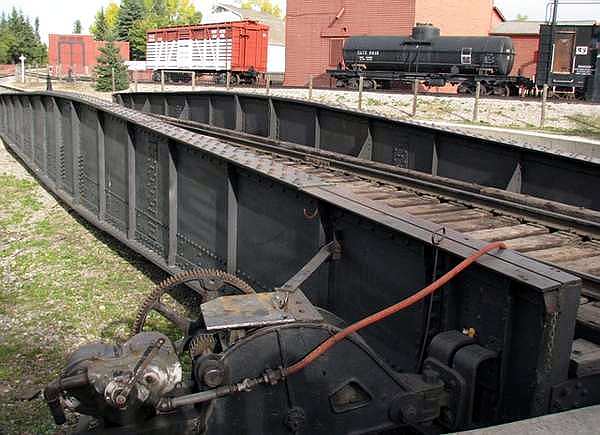 | One of the key elements of Heritage Park, is the turntable, allowing it to turn their artifacts around when needed or shunt them to a different location. A turntable is almost always installed in front of a locomotive roundhouse. Its origin is unclear. To the best of the Park’s knowledge, it was built in 1907 or 1922 at the Canadian Foundry Company in Winnipeg. First installed in train yards in North Bend, B.C., 60 kilometres north of Hope, it was later relocated to Arrowhead, B.C., and then Sicamous, B.C. In 1981, the Canadian Pacific Railway donated the turntable to Heritage Park. http://www.heritagepark.ca/plan-your-visit/attractions- and-exhibits/railway-turntable.html |
| This picture taken and was submitted by Massey F. Jones | |
 | The Heritage Park is air-operated by the red hose shown in this picture which is then attached to the locomotive air compressor. A lever then allows the table mechanism to turn at a selected rate. When not in use, the gears are covered. Some non air-operated turntables have been called “Armstrong turntables” by railway crews, meaning that strong arms were needed to activate the turntable, by hand, while pushing on it. View one at: http://www.youtube.com/watch?v=OzIt7YN9Fx0. The little blue and white beauty being turned in the video is a GE 25-ton switcher. http://www.cteastrrmuseum.org/GE25.htm |
| This picture taken and was submitted by Massey F. Jones | |
 | Among other artifacts in the Heritage Park collection is tank car 6010, built in 1935 and formerly owned by The Canadian General Transit (CGTX), who leased them to railways. In 1930, there were 104 different commodities being shipped (such as acid and vinegar) in 140,000 tank cars but by 1939, 15,000 less tank cars due to the Depression. Older ones (mostly with wooden exteriors) were then dismantled. |
| This picture taken and was submitted by Massey F. Jones | |
 | Stock Car 20006 in the Heritage Park collection. The car was built in 1912 by The American Car & Foundry (ACF). They produced stock cars like these for decades during the last century, straddling both the steam and diesel eras |
| This picture taken and was submitted by Massey F. Jones | |
 | CPR 2023 ready to go on the turntable during Railway Days, at Calgary’s Heritage Park late summer Railway Days is a 2-day celebration of railway operations, telegraphy and exhibition of railway artifacts. CPR 2023 is placed on the 1907 turntable for a public demonstration on how it works, while the other carries on with ticketed passengers, twice around the property for about 45 minutes. |
| This picture taken and was submitted by Massey F. Jones | |
 | Heritage Park CPR 2023 and 2424 double heading over the only rail bridge on the property, during Railway Days in July 1988. Note the people in the lower left corner who have more than a passing interest. While one engine hauls a passengers around the property, the other one will haul a freight consist. Then they are both are combined as a “mixed train” and run around the property a few times. |
| This picture taken and was submitted by Massey F. Jones | |
 | CPR 0-6-0 #2023 (Ex US Military) Heritage Park CPR 2023 going over the only rail bridge on the property |
| This picture was submitted by Jim Parker and is part of the Frank Smeltzer Collection | |
 | CPR Class U3 0-6-0 #2023 June 1984 Heritage Park CPR 2023 going over the only rail bridge on the property |
| This picture was submitted by Jim Parker and is part of the Frank Smeltzer Collection | |
 | The only trestle in Calgary’s Heritage Park, designed for drainage, instead of using a culvert. Trestles are custom built to fit the scenery. This one was erected in 1973 as a gift from the Canadian Pacific Railway. The water barrels on the left side of the trestle are for fire fighting, in case the locomotive should accidentally drop cinders on the trestle. |
| This picture taken and was submitted by Massey F. Jones | |
 | Locomotive 2023 brought out early morning for a special function in 2005. The normal Heritage Park train consist is composed of either 2023 or 2024 and passenger cars Morrissey, Fernie & Michel Ry 62 and 63, built around 1885; as well as Canadian National Observation Car 15097, built in January 1892 and featured in two photos on this page. All are seen here. To prevent excessive rail wear, the train runs clockwise one year and counterclockwise the following year during the visitor season, May to September. A ride around the park is usually twice around the property and lasts about 45 minutes. Ticketed passengers can get off at any of the 4 stations and re-board. Michel, now a ghost town, was once a thriving community of 1000 people in the BC “Crowsnest Pass”, which, at the turn of the century, featured several coal mines. The Morrissey, Fernie and Michel Railway connected the Coal Creek mines with the Canadian Pacific and the Great Northern railways at Fernie. Gas outbursts led to the closure of the Morrissey operations in 1909. http://www.crowsnest.bc.ca/coal03.html |
| This picture taken and was submitted by Massey F. Jones | |
 | CPR Class U3 0-6-0 #2023 June 1984 |
| This picture was submitted by Jim Parker and is part of the Frank Smeltzer Collection | |
 | CPR Class U3 0-6-0 #2023 June 1984 |
| This picture was submitted by Jim Parker and is part of the Frank Smeltzer Collection | |
 | CPR 0-6-0 #2023 (Ex US Military) June 1987S |
| This picture was submitted by Jim Parker and is part of the Frank Smeltzer Collection | |
 | CPR 0-6-0 #2023 (Ex US Military) June 1987 |
| This picture was submitted by Jim Parker and is part of the Frank Smeltzer Collection | |
 | Here’s a CPR locomotive that’s never been on CPR tracks, except perhaps to be transported. “CPR 6269” Lima-built 0-6-0 locomotive started life in 1944 and joined the US Army in 1946 as their 4076, before coming to the Pacific Coast terminals in 1964, then to a private owner in December 1967 and finally to Calgary’s Heritage Park that year. The Park ran her as “CPR 6269” from 1967 to 1969, before repainting her to her current “CPR 2024”, along with sister “CPR 2023” , an ALCO 0-6-0 locomotive with about the same Army and civilian history but built two years earlier in 1942. |
| Photo: L. Unwin Collection Massey F. Jones | |
 | Heritage Park operates either 2023 or 2024 daily and at very frequent intervals around a circular the property. A train ride consists of 2 laps with several stops at various stations to pick up passengers. All Heritage Park staff wears period costume. Once a year in late summer on “Railway Days”, a two-day event, Heritage Park double-heads 2023 and 2024 and runs a mixed consist of freight and passenger. Either 2023 or 2024 is then brought to the roundhouse, placed on a turntable and the practice is demonstated.http://www.heritagepark.ca/specialevents.htm |
| Photo: L. Unwin Collection Massey F. Jones | |
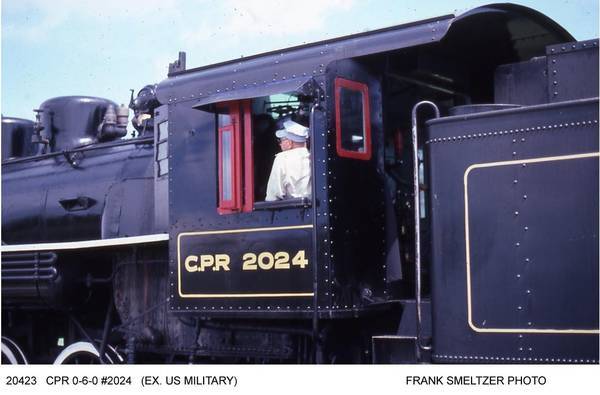 | CPR 0-6-0 #2024 (Ex US Military) June 1987 |
| This picture was submitted by Jim Parker and is part of the Frank Smeltzer Collection | |
 | Tucked into a quiet area of Heritage Park behind Laggan Station, is Crowsnest Pass Coal 3, a saddletank locomotive, formerly used for hauling coal out of the mine to the tipple for washing. The term “saddletank” refers to the fact that the water tank straddles the boiler, saving space, since the loco doesn’t require a tender. CNP 3 is a 42”gauge 0-4-0T built by Vulcan Iron Works of Wilkes-Barre Pennsylvania in December 1902. Vulcan Iron Works was a builder of small mine locomotives but not as big as its competitor, Porter, and it closed down in 1950. For obvious reasons – fire and smoke are bad in a coal mine – CNP 3 mostly operated outside, towing small rickety wooden cars, one of which is displayed behind the loco. Weighing 32,000 lbs (14515 Kg) empty, CNP 3 was given to Heritage Park in 1965. This view is from the road. |
| This picture taken and was submitted by Massey F. Jones | |
 | The engineer’s side of the locomotive. For many years, the display wasn’t fenced. A sign on the other side now tries to prevent further deterioration of this historical artifact. View a photo of the locomotive when it wasn’t fenced at: http://trains.nute.ws/0-4-0/CNP3.htm At that time, the loco was also in a far more pristine condition. Like other Heritage Park artifacts, it may be someday restored, but not to operating condition. |
| This picture taken and was submitted by Massey F. Jones | |
 | A string of small wooden cars inside the mine, were brought to the surface by “Thermos bottle”, high pressure steam or air locomotives (600-800psi) that could be recharged at various stations in the mine and looked like a large water tank, laid down on rail wheels. Most of these underground locomotives were built by HK Porter. Beingfireless, those did not represent a danger. With no operator cab due to cramped conditions, they simply pushed the load up an incline to the surface, where CNP 3 took over. When the rickety coal cars became too worn out, they were simply replaced by building a new one at very low cost on the same set of wheels. The track in front is part of a wye, used to back up a locomotive to the square water tank shown elsewhere, rather than go all around the Heritage Park perimeter again. |
| This picture taken and was submitted by Massey F. Jones | |
 | The ornate plaque, showing the construction number on the boiler of 0-4-0T mine locomotive CNP 3 at Heritage Park. The Crowsnest Pass Coal Company operated in the Fernie area of Southern BC from the late 1890s to the late 1950s. By that time, coal was on the decline and most mines of Alberta and BC closed down. Some coal mines still exist in the area, now exported to Asia, but the companies do strip mining. |
| This picture taken and was submitted by Massey F. Jones | |
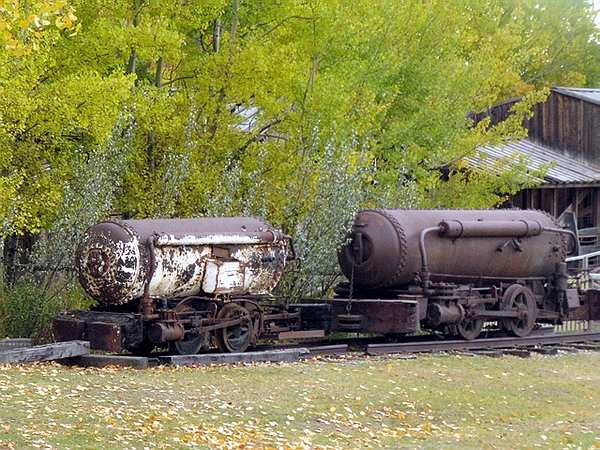 | These two are two Compressed Air mine locomotives, displayed the Natural Resource area of Heritage Park. The six-ton locomotive in front was used in Canmore for nearly 80 years, before Canmore Mines Ltd donated it to Heritage Park in 1979, while the one eight-ton locomotive in the back, nicknamed “Jumbo” was used for 40 years at the Crowsnest Pass Coal & Coke Company at Michel BC, before being presented to Heritage Park as a gift in 1965. Both units were built by the H.K. Porter Company Ltd, the largest manufacturer of mine locomotives; one in 1909 and the other one in 1902. Being fireless, compressed air locomotives were used inside the mine itself and pushed the cars to an outside area, where steam locomotives such as CNP 3 or the Canmore 4 “Goat” both shown on this page, took over. |
| This picture taken and was submitted by Massey F. Jones | |
.jpg) | These 3 flatcars, yet to be restored are one of two displays on a side track in the “Railway Section” of Heritage Park. Left to right: CPR 306684 (aka OY22), CPR 311386 (aka OY21). It’s impossible to read the markings on the 3rd car but it’s also from the CPR and the same era. |
| This picture taken and was submitted by Massey F. Jones | |
.jpg) | Of the 3 flatcars, the most interesting is CPR 311386, which has a set of Can-Car trucks as a load. |
| This picture taken and was submitted by Massey F. Jones | |
.jpg) | Morrissey Fernie & Michel Railway flatcar 53, coupled here on exhibition the rear of Heritage Park snowplow CP 400884. MF&F was a holding company catering to the CPR coal supply and it operated in Southwestern BC near the Alberta border. The load is very likely tied to the coal industry. One of its two lines was built by the Canadian Pacific in 1900 and leased by the Cows Nest Pass Coal Company (owners of the small No 3 on this page) and it was built to connect the mines at Coal Creek and at Morrissey with the Canadian Pacific and Great Northern railways. In addition, free passenger trains operated several times each day to provide transportation for the miners who lived in Fernie. The cars are features somewhere else on this page. |
| This picture taken and was submitted by Massey F. Jones | |
 | Snowplow CP 400884, on a siding at Heritage Park on July 1st, 2014, coupled between CP Tender 415722 and Morrissey Fernie & Michel Ry #53, shown elsewhere on this page. While today’s road locomotives have a small plow in front, bigger snowdrifts require one of these, known as a “Wedge Plow”. Weighing in at about 20 tons, the plow has no power on its own and must be pushed by a locomotive. Average plowing speed on mainlines is about 50 mph. See one in action at the beginning of https://www.youtube.com/watch?v=VzqRQr8tQPQ At the very bottom of the plow is a blade or “tongue”, which is adjusted by the operator so it doesn’t catch any obstacle while plowing between the rails. The snow flies up the tongue into the plow, throwing it on both sides of the unit. If a wider swath is desired, the side mounted wings are extended. The operator which sits above the plow in the cupola controls the plow with only 2 gauges. One for monitoring air pressure to the plow brakes and the other one to monitor the cylinder pressure necessary to raise and lower the blade and actuate the wings as well as the whistle used by the plow operator to signal the locomotive engineer. A very distinct code applicable to plows only is used for Stop at once (o), Move backward (o_o) and Move forward (o). “o” indicates a short sound and “_” indicated a long sound. In this case, it is sometimes better than radio transmission and unmistakable. The cupola also contains a heating stove. While it looks simple, the plowman must be familiar with the track layout and various obstacles along the way as well as when to raise the blade to prevent damage which could derail the plow while at speed, if the tongue encounters a heavy immovable object. The original number for the Heritage Park snowplow was 300884 when manufactured in December 1911 and it became renumbered into the 400XXX series when 36 newer units were manufactured in the CP Angus Shops between 1920 and 1929 in that series. |
| This picture taken and was submitted by Massey F. Jones | |
.jpg) | The rear of Snowplow 400884, built in December 1911 at the Canadian Pacific Angus Shops, in the East End Montreal Rosemont district (a blue collar area). http://members.kos.net/sdgagnon/ang.html . Angus shops were the main repair shop for Eastern Canada and lasted about a century, before being decommissioned in 1992 and the land redeveloped into housing and parks. Some of the buildings re-purposed. http://www.cmhc-schl.gc.ca/en/inpr/su/sucopl/upload /Angus-Montreal-Quebec.pdf Both sides have extendable wings and you can see the four hinges on which they’d swing out to about 12 to 14 feet for plowing to the side. Plows are usually pushed at speed (50-60 mph) by one or more diesel locomotive and have adjustable “tongues” in front to control the depth of plowing and the wings are also adjustable. Specific trackside signs alert the plowman to raise or lower the tongue, because the plow can easily derail if it hits an obstacle such as a turnout (switch). |
| This picture taken and was submitted by Massey F. Jones | |
 | Detail from wedge Canadian Pacific plow 400884 at Heritage Park. The centre portion is adjustable and the operator must ensure that it clears the ties, turnouts (switches) and other protruding objects between the rails while the side blades clear the top of the rail. The air hose hanging down is from the previous car. Snow is lifted by the blades and pushed into the wedge, which them throws it on each side of the track. This type of plow is used for single track only. Double track plows use a design which features a flat portion on one side, such as shown on this page with CNR 55501 and especially well with CN 23475 snowplows. |
| This picture taken and was submitted by Massey F. Jones | |
.jpg) | Canadian Pacific Tender 415722 was built in 1907 by the Richmond Locomotive and Machine Works of Richmond, Virginia in 1907 to be matched to Canadian Pacific D-10 Class, 4-6-0 locomotive No. 613 http://members.shaw.ca/cprsteam/d10a-d10k.htm The tender gets periodically switched around Heritage Park as an outdoor exhibit. The fireman’s side is seen here on July 1st, 2014. |
| This picture taken and was submitted by Massey F. Jones | |
.jpg) | CP Tender 415722 coupled to CP now Plow 404884 and CGTX Tank Car 6010 on a siding at Heritage Park on July 1st 2014. Heritage Park likes to restore their railway artifacts in pristine condition, as good or better than when they were in use and move them around from year to year within the railway-themed area of the Park to showcase them. The track in front is their “Mainline” |
| This picture taken and was submitted by Massey F. Jones | |
.jpg) | One of the best kept secrets of Heritage Park is “Lil” Pat, brought out occasionally to shunt cars around various buildings, instead of using their dieselized steam engine The loco is seen in these views in front of the Heritage Park Car Shop. “Lil” Pat is a 20-ton yard switcher and a builder’s plate could not be located on the frame to indicate the model, serial number etc. Some web research determined that it’s probably a Whitcomb type 20DM, built between 1946 and 1952 (possibly closer to the latter, due to the truck-style grille – early models had a flat grille). The first two numbers stand for the weight and the next two for the engine /drive combination. DM is for Diesel-Mechanical. There is also a series of numbers and letters which would follow, indicating variants of the model. View a couple of this type of locomotive at http://www.northeast.railfan.net/images/tr_brcs7.jpg and http://www.northeast.railfan.net/images/dgp1.jpg |
| This picture taken and was submitted by Massey F. Jones | |
.jpg) | Whitcomb started production around 1906. In the beginning, the company only produced locomotives up to 10 tons, for use in mining operations (Some possibly replacing steam locos, such as the CNP 3 shown on this page, outside the mine shaft). In 1930, the company filed for bankruptcy and was taken over by the Baldwin Locomotive Works, which owned a majority of Whitcomb stock. It still operated as the Whitcomb Locomotive Works; until in 1940, when itbecame a division of Baldwin, producing hundreds of the US government for use in Europe and the US during WWII. Many of these little giants operated on dockyards and into munitions factories, shunting cars many times their own weight. View a Baldwin poster, promoting their Whitcomb line, at: http://en.wikipedia.org/wiki/File:WWII_print_ advertisement_for_Baldwin_Little_Giants.jpg |
| This picture taken and was submitted by Massey F. Jones | |
.jpg) | Following WWII, many of these little locos were sold to mine and gravel pit operators and to others who demanded a reliable and rugged locomotive that would go on and on at low cost, to the point of extreme abuse and still run. While many still employ Whitcomb locos today (mostly around tourist operations), most industries are now using the more versatile “Trackmobile”, which can operate on off railway tracks. View one in action at: http://www.youtube.com/watch?v=IUAeFzGbt4U Whitcomb industrial locomotives ranged, from 2-ton battery locomotives used in underground mine work, to 100-ton oil-electric models used in road work. Production of the Whitcomb locomotive line came to an end in March 1956 after producing approximately 5000 locomotives. Those truly interested in Whitcomb can access: http://www.northeast.railfan.net/diesel96.html . Other sites in the North East Rails series address Whitcomb locos of higher size and capacity. All with an individual thumbnail, that can be brought to full screen. |
| This picture taken and was submitted by Massey F. Jones | |
.jpg) | “Lil” Pat and CP 2018 displayed in front of the Car Shop. On the extreme left, Heritage Park staff give rides to visitors on a hand cart during Railway Days, September 28-29, 2013. In the very back, Construction Car 76, built in 1882 (shown on this page) |
| This picture taken and was submitted by Massey F. Jones | |
.jpg) | There isn’t much to the cab of a 20-ton Whitcomb . The basic controls are shown here. To the left is a large vertical 900 L or so (about 200 imp gal) fuel tank, a fire extinguisher and a toolbox. Operating the Whitcomb is one-man job. |
 | A lot of owners liked to call their little giants “Li’l something”and this one is no exception. The following is from Brian Manning Chief Engineer/Chief Railway Mechanical Officer Heritage Park Historical Village® “Lil Pat was donated to Heritage Park by Orica in Carsland. They used it as a yard shunt engine, and had done extensive work to it including a rebuild on the Twin disc clutch and installing a new 250 Cummins diesel engine to replace the old Buda unit. They parked it soon after and replaced it with a new Trackmobile. It is a 1942, 25 ton Whitcomb ser #40738, and was owned by Continental Explosives LTD (CIL) and was originally used on James Island, BC.” |
| This picture taken and was submitted by Massey F. Jones | |
 | CNR Tourist Observation Car #15097 at Toronto Ont. July 1967 This car was built in 1892 and is now at Calgary’s Heritage Park and in daily operation during their open season, May to September. View it on YouTube by accessing “Calgary’s Heritage Park Steam Train” http://www.youtube.com/watch?v=GRPHKvYIbWA |
| This picture was taken and submitted by Jim Parker | |
 | CNR Tourist Observation Car #15097 at Toronto Ont. July 1967 This car was bui;t in 1892 and is now at Calgary’s Heritage Park and in daily operation during their open season, May to September. View it on YouTube by accessing “Calgary’s Heritage Park SteamTrain” http://www.youtube.com/watch?v=GRPHKvYIbWA |
| This picture was taken and submitted by Jim Parker | |
.jpg) | The interior of CN 15097 Open Observation Car. Most Heritage Park visitors prefer to ride in the rear section. Sharp eyes will notice that the leather seats are also reversible, depending upon the choice of facing for the trip by the passenger or train direction. A video posted by Massey at: http://www.youtube.com/watch?v=GRPHKvYIbWA takes the viewer for a ride on the platform of this car for a portion of the Heritage Park loop. |
| This picture taken and was submitted by Massey F. Jones | |
 | Morrissey Fernie &Michel Coaches 62 and 63 behind locomotive CPR 2024, at the end of the day’s run Missing is Observation Car CN 15097 (shown on this page), now uncoupled. The train is about to be wyed on a track to the left and backed up to the rectangular enclosed water tower seen elsewhere on this page MF&M 63 is at the rear. MF&M 63 was built in 1902 and MF&M 62 dated from 1885. Morrissey Fernie & Michel Railway served a mine in the Crowsnest area of Southern BC (Alberta/BC border) http://www.crowsnest.bc.ca/branchlines05.html. You can see the car in action up close (including this picture) during a 15 minute video on the Heritage park steam train which Massey posted at: http://www.youtube.com/watch?v=GRPHKvYIbWA |
| This picture taken and was submitted by Massey F. Jones | |
 | The interior of Morrissey Fernie & Michel 63. One word describe the comfort: functional. |
| This picture taken and was submitted by Massey F. Jones | |
 | Calgary Municipal No 14, more familiarly called the Heritage Park Streetcar and formally known as The ENMAX Electric Streetcar System; heading home empty on the last trip of the season, October 14th 2013 around 5:00 pm. Car 14 was the very last streetcar to run in Calgary, from the Ogden CPR shops to City Hall downtown on December 29th, 1950. It was donated to Heritage Park in 1973, who restored it, to move visitors from the corner of 14th Street SW and Heritage Drive to the main gate. The car is double-ended with the trolley pole simply lowered at the end of the run and the other one raised before the streetcar reverses direction. Between 2007 and 2010, the Park underwent a great expansion. At that time, the streetcar tracks were removed and then reinstalled on a new route, doubling the journey. Enmax (formerly The City of Calgary Electric System – now a private corporation) was the major sponsor. More streetcar parts were found and donated to Heritage Park, which then built a replica (No 15) in 1991. During the summer season, either or both streetcars operate between the parking lot and the main gate. While walking from the different parking lots to the main gate is not too far, taking a noisy trolley the long way around for about 15 minutes or so is a lot more fun for a loonie (the Canadian dollar coin) |
| This picture taken and was submitted by Massey F. Jones | |
 | The interior of Heritage Park #14 or #15. The streetcars are mostly alike inside and outside and used alternately. Streetcar operation is daily during June, July and August but weekends only at the beginning and end of the visitor season. More details and a 15-minute technical video of No 15 in action at: http://www.youtube.com/watch?v=mIF0QlU99uU |
| This picture taken and was submitted by Massey F. Jones | |
 | The double-door setup of Heritage Park cars 14 and 15, also called by some “a Prairie Style Door”. The other side at the back is identical. Thomas Henry McCauley, superintendent of the Calgary electric streetcar railway, from the beginning in 1909 to his retirement about the 1940s, designed the system in order to enable an ever growing Calgary population to board and alight quickly during rush periods on the busier routes. He held several streetcar patents over the years. The door mechanism patent was filed on 5 June 1917 and issued on 20 Nov 1917 (now CA 180474), while the door patent was filed on 5 Jun 1917 and issued 22 Jan 1918 (now CA 181729). Both original submissions are now on archives at the Canadian Intellectual Property Office in Ottawa. The Patent also made its way to the States as US 1249976 http://www.google.com/patents/US1249976 The latter gives a better read than the pdf files, which are a scan of the 1917 originals. |
| This picture taken and was submitted by Massey F. Jones | |
 | Car #15 with the door open |
| This picture was submitted by Massey F. Jones | |
| Specification of Letters Patent. Patented Dec. 11, 1917 Application filed February 28, y1917. Serial No. 151,475.v To all whom it may concern. Be it known that I, THOMAS HENRY MCCAULEY, a citizen of the Dominion of Canada and subject of England, residing at Calgary, in the Province of Alberta and Dominion of Canada, have invented new and useful Street-Car Doors, of which the following is a specification. The present invention relates to street car doors, and aims to provide a novel arrangement of the entrance and exit doors, providing for compactness in construction, and enabling the entrance and exit doors to be placed at the front end of the car with a short vestibule, such a vestibule being of advantage in that it will not overhang the opposite track in turning corners. The present invention also enables ordinary short vestibule single entrance cars to be converted into the double door construction, or to be equipped with the entrance and exit doors at one end in a compact arrangement. Another object of the invention is the provision of novel means for operating either or both of the entrance and exit doors, in order that they can be operated individually or jointly. It is also within the scope of the invention to provide the aforesaid improvements, which are of comparatively simple construction, which can be readily installed without prohibitive alterations or expense, .and which will increase the efficiency and utility of the car. ……………… Thomas Henry McCauley also provided an invention patent for a mechanism to open and close the door from inside and retract the step while the car was running. Of note in these pictures is the large “cowcatcher”, prominent in these days to scoop up anything that might fall in front of the streetcar (mostly pedestrians not yet familiar with the streetcar speed at crossings). Note the air whistle on top of the centre window. | This is an extract from the patent for the “Prairie” style door on early Calgary Transit streetcars. (some typos corrected for the purpose of this caption) |
| Massey F. Jones | |
 | The controls on Car #15 |
| This picture was submitted by Massey F. Jones | |
 | The controler on Car #15 |
| This picture was submitted by Massey F. Jones | |
 | Car #15, arriving back to the main Heritage Park main gate, after ferrying passengers to and from their car in the parking lot. The uniformed conductor is just opening the Prairie-style door, locally invented by Calgary Electric Superintendent McCauley and getting ready to off-load passengers at ANDREW station, by the main gate within a minute or two. Car #15, built in the Heritage Park shops, is a replica of Car #14, which was the very last streetcar to run in revenue service on the streets of Calgary. The two cars are used alternately in season. |
| This picture was submitted by Massey F. Jones | |
 | The conductor and the motorman are waiting for the last passengers at ANDREW station by the main gate. before Calgary Electric Car #15 departs for the parking lot through about one kilometer of track which takes about 10 minutes end-to-end with all the proper sounds and ride. There is a station at either end and one about the middle and they are named for a major donor. To mark its 50th Anniversary season, unlimited rides on the steam train, the streetcar and the SS Moyie paddle wheel boat have all been included in the 2014 Heritage Park admission price. This telephoto shot is taken from a hill accessible to all, but a bit removed from the public area. |
| This picture was submitted by Massey F. Jones | |
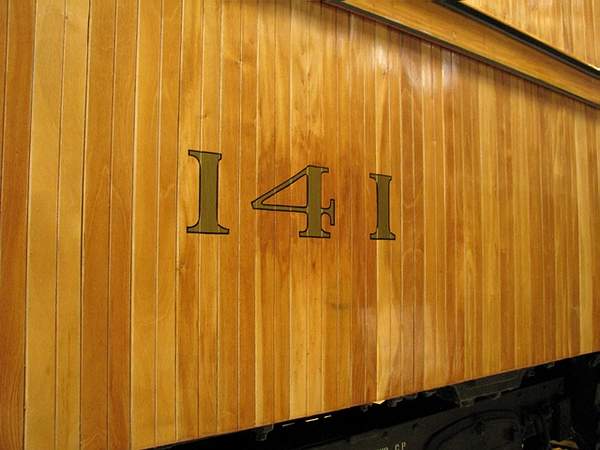
 | CPR Car #141 was constructed in Montreal in 1907 to serve on suburban duty, probably to the West Island, an area served today by modern trains, just past P-E Trudeau airport (YUL). The reversible rattan seats can be oriented for the direction of travel once the train reached its destination, without need to turn the car around. It’s next assignment was as part of a ski train, which the CPR inaugurated to the Laurentian Mountains around 1926-1927, ferrying about 10,000 passengers per weekend between Windsor Station in downtown Montreal to areas such as Ste-Agathe and Shawbridge, about 60 miles (100 km) north. Many skiers went up on Friday and came back on Sunday. In 1951, the car was withdrawn from passenger service and converted internally to a bunk car to accommodate CPR maintenance crews and assigned to the CPR subsidiary Dominion Atlantic Railway as DAR 411585, operating around Kentville NS. http://www.dardpi.ca/wiki/index.php?title= File:411585_(1).JPG |
| This picture was taken and submitted by Massey F. Jones | |
 | Fate intervened in the mid-1970s when an older railcar car couldn’t be used for the filming of the 8-part series “The National Dream” and DAR 411585 became required as a stand-in. The exterior was then restored at the Weston Shops in Winnipeg to resemble a passenger car of the 1880s and renumbered to 141. Fate intervened in the mid-1970s when an older railcar car couldn’t be used for the filming of the 8-part series “The National Dream” and DAR 411585 became required as a stand-in. The exterior was then restored at the Weston Shops in Winnipeg to resemble a passenger car of the 1880s and renumbered to 141. http://www.dardpi.ca/wiki/index.php?title=File:141.jpg After the TV series which ran in 1974, CPR ran a display train, to complement their “CP Bygone” store at Windsor Station in Montreal where surplus artifacts could be procured, such as railway dinnerware and CPR Beaver heralds formerly used on their passenger cars.. In addition to showcasing the CPR history to the public, it made acquisition of some artifacts possible. The train toured Canada, with a business car at the end for the crew. |
| This picture was taken and submitted by Massey F. Jones | |
 | The information board on the Car # 141 platform, mentions that Car #141 was used at one time, transporting passengers between Winnipeg and Winnipeg Beach; about 45 minutes north of Winnipeg on the shores of Lake Winnipeg. It was probably its last assignment, before being decommissioned by the CPR |
| This picture was taken and submitted by Massey F. Jones | |
 | In 1980, it was acquired by Heritage Park who refinished it to its present state. In 1989, following restoration Car #141 won the annual Canadian Railroad Historical Association “Preservation Award”. Car # 141 is the last varnished mahogany railcar in North America and because of its historical value; it is not run as part of its steam train. Normally stored in the Heritage Park Car Shop it is displayed between Construction Car 76 and the replica of the Winnipeg Horse Car and is available for daily visit by the public but only brought out of storage for special occasions, such as for Railway Days each September. |
| This picture was taken and submitted by Massey F. Jones | |
 | In the early 1900s, Canadian Pacific Railway agents were aggressively recruiting applicants, home and abroad, to help develop Western Canada. Overseas immigrants were sold a package which included a combination of CP ship travel and passage on a CP train, leaving either from Halifax (Pier 21) Quebec City or Montreal. CPR also sold them land at $2.50 and up an acre that required cultivation once they arrived at destination. Higher amounts featured a basic house on the premises. “Colonists” paid only $7.00 in passage from Montreal but were expected to be self-sufficient and look after, not only their family, but also their livestock, located a few cars ahead of the colonist car. Supplies enroute were of course sold by the CPR, but most colonists chose to travel at low cost, with only minimum of comfort for 7 days between Montreal and Calgary. For others leaving from Eastern Canada, railway fare from Montreal was $23.00 for First Class and $18.00 for Tourist Class passengers |
| This picture was taken and submitted by Massey F. Jones | |
 | A few of the colonist cars had served as troop sleepers during WWI and a few continued their life by being upgraded for troop travel during WWII. Car 2658 in Calgary’s Heritage Park, built in 1912 is one of two relatively-intact CPR wooden colonist cars in existence today and one of only 3 such cars in existence across Canada; others being the CPR 2514 at the West Coast Railway Association Museum in Squamish BC and the CNR 2929 at the Canada Science and Technology Museum in Ottawa. This view in September 2013, of the Ladies’ end of Colonist Car CP 2658 shows therestoration that is needed and will soon be undertaken. |
| This picture was taken and submitted by Massey F. Jones | |
 | The “Men Only” smoking section of Colonist Car 2658. Women were not allowed there because, until 1929 in Canada, they were not considered “Persons” and therefore were confined to the rear, with their children. These upholstered seats were about the only comforts of the car. While women prepared meals and looked after the children during the 7-day trip, most men rode with their livestock, which also had to be fed and watered. Livestock cars were generally placed ahead of the Colonist car in the train for easy access. It also ensured that colonistswouldn’t mix with passengers in other classes, who had paid a higher fare. |
| This picture was taken and submitted by Massey F. Jones | |
 | Each family was given one hour to prepare a meal for themselves. Children were notallowed off the train, lest they wander off and get left behind. This “Golden Nugget” wood stove, manufactured by the Gurney Foundry in Toronto was located in a small kitchen, opposite the Ladies’ end of the car. Each car featured only basic sanitation, such as a wash stand and a toilet at each end. |
| This picture was taken and submitted by Massey F. Jones | |
 | Cars such as CPR 2858 slept 72 people in 18 sections (4 per section). A board was placed between the two lower seats, so that it could sleep 2 people at night, while two more people were expected to occupy the upper berth. No mattress was provided but CPR would sell one for a dollar, same price for a wool blanket. Pillows were35 cents each and curtains for privacy cost a dollar a pair. |
| This picture was taken and submitted by Massey F. Jones | |
 | Replica of a coupon, given by the conductor for re-boarding Section 6, Car 9125 of Train 91 between Montreal and Calgary, leaving at 5:40 pm Standard Time Aug 27, 1910 and only valid with ticket 60964 . If they so desire, Colonist car 2568 visitors can request a free replica as a memento from the CPR-uniformed Heritage Park staff member after attending his 45-minute play where they become 1907 “Colonists” and listen to a presentation of what their contract entails and what is expected from them during the 7-day trip. |
| This picture was taken and submitted by Massey F. Jones |

 | Canadian Pacific “Heavyweight” passenger car RIVER FORTH undergoing re-construction in the roundhouse at Heritage Park in Calgary. Heritage Park purchased it from the CPR without wheels but in apparent good condition. Formerly an elegant Solarium Observation Car it ended its working days as a bare-boned work car, left to decay in the rail yard south of Calgary. RIVER FORTH was built in 1929 for the “The Trans Canada Limited” http://www.crowsnest.bc.ca/tcltd/history.html a First Class Service and the ancestor of today’s “The Canadian” and later used by the Soo Line (the CPR US subsidiary) on the “Mountaineer”, between St. Paul, Minnesota and Vancouver and other “named” CPR trains. http://sooline.railfan.net/resources/timetables/ 55ptt4.jpg The Great Depression of the 1930s saw all but 4 of these elegant cars put into storage. The River Forth continued to operate on the Mountaineer during the summer months, before the car was reconfigured with sleeping compartments and renamed CAPE KNOX in 1943. It became CPR Business Car 21 in 1962 and finally Boarding Car 411752 in 1974 on work trains, before being stored south of Calgary at Skiff Alberta, without wheels but earmarked for donation by the CPR; since the car was still relatively intact inside and out. http://tracksidetreasure.blogspot.ca/2014/01 /cp-stored-cars-at-skiff-alberta.html |
| Photo: Massey F. Jones, courtesy Heritage Park | |
 | With the car completely gutted and stripped, CPR “RIVER FORTH” is undergoing an extensive transformation in closed off area of the Heritage Park roundhouse. CPR’s Solarium-Lounge Car came to Heritage Park without wheels but was perceived to be fairly intact inside and out. When rolled out again, the car will be used for special events as well as available fine dining experiences, reflecting the elegance of a bygone era. Funds gathered will be used to restore the Colonist Car, shown in these pages. |
| Photo: Massey F. Jones, courtesy Heritage Park | |
 | Heritage Park posted these 3 photos on the wall in its roundhouse, to give the general public an idea of what CPR “RIVER FORTH” looked like upon arrival at Heritage Park and what it will look like after the work is complete. The photos are just a general concept for now but Heritage Park has a history of restoring things to pristine condition. When completed, the car will be rolled out for fine dining on Heritage Park track. Funds raised through the rental of the dining car will be put towards restoring another important piece of Western Canada’s rail history, a 1912 wooden Colonist Car. |
| Photo: Massey F. Jones, courtesy Heritage Park | |
 | The solarium portion of the car to the tail end of the train will provide guests with a relaxing place to lounge around, while on Heritage Park track. In the original car, nothing was spared to make this section attractive and the tall windows in that section were covered with “vita glass”, which was said to have special health benefits; containing quartz for transmitting the ultraviolet rays of sunlight; the refined chemistry of “vita glass” promising to ‘let health into an area’ that ordinary s oda-lime glass blocked, hence people flocked to the solarium (sun) car to avail themselves of that healthy benefit. |
| Photo: Massey F. Jones, courtesy Heritage Park | |
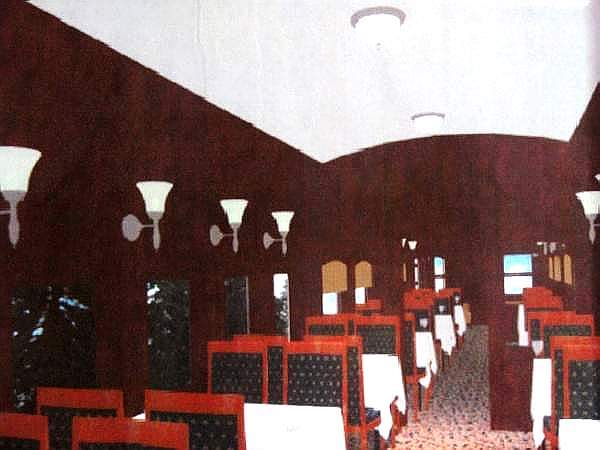 | Solarium cars were constructed for the comfort of long distance passengers and, while there was a dining car on the train providing full meals, sales from the buffet in this car generated extra revenue for the railway. Fine dining is the main purpose of this section and Heritage Park will make RIVER FORTH available for special events, as a fundraiser to refurbish the Colonist Car shown on this page. |
| Photo: Massey F. Jones, courtesy Heritage Park |